
Despite Charles Malik's prolific career and accomplishments on the world stage, his written legacy has largely been lost to history, falling out of circulation or never making it to print. It survives in hard-to-access libraries and sometimes in languages foreign to Western readers.
The Library of Congress in D.C. holds the largest collection of Malik's work with 114.8 linear feet of material. Below you will find the Charles Malik Institute's ongoing effort to mine this archive, with occasional additions from other libraries, and bring Malik's work back into public discourse.
Upcoming Events
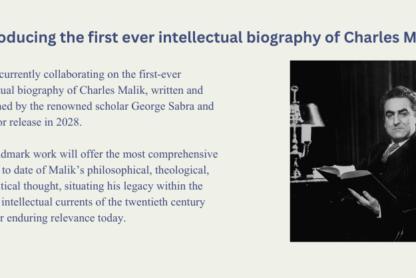

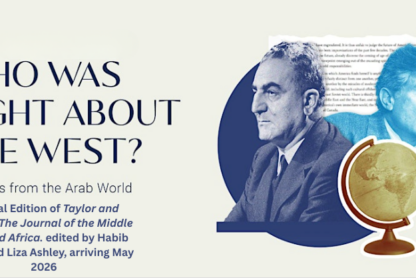
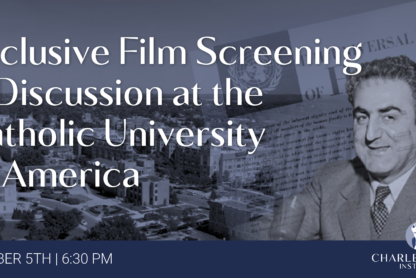
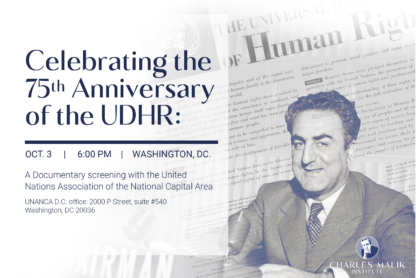
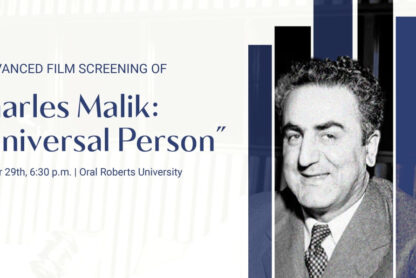

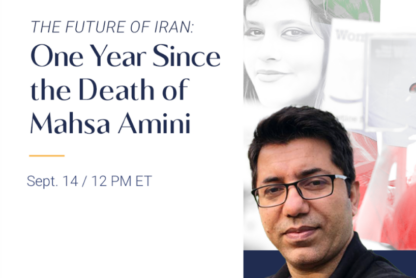


Past CMI Events
Want to review our past events?

"There is plenty of material injustice in the world, but intellectual and spiritual injustice is infinitely more significant. There is inherent injustice so long as the great literature which is available, for instance, to American youth is entirely out of proportion to that which is available to the youth of other parts of the world. When I enter certain American or European homes and find what the boys and girls of those homes can read and study, from Homer to Tolstoy, and reflect at the same time that this wealth of literature, which has helped to make history more than anything else, is not open to the youth of other lands, except insofar as they have learned a European language, I feel deeply disturbed. There is a great tradition of human thought and sentiment which is known and participated in by only a fraction of humanity. This is quite unfair. To have some peoples and nations enjoy the infinite riches of the mind while the rest of humanity wallows in darkness and error is an act of injustice of the first order…. There can be no peace, there certainly can be no real justice, so long as the goods of the mind and spirit are abundant in some countries and miserably deficient in others; so long as the great classics of human thought and feeling, from Plato to the present day, have penetrated and transformed the life and literature and outlook of certain countries and are totally unheard of in others; so long as the supreme persons of history belong to the living tradition of certain countries and are absent from others. The ultimate ground of peace is participation in a community of generis ideas. Such a community can be culled from the great classics of the past…. We are often urged to work for what is ambiguously called “rising standards of living.” Now I firmly believe we should do that. But what about rising standards of thinking and feeling? Shouldn’t we also work for that? Or is it that the refinement of the mind and spirit would automatically and magically follow upon the abundance of material goods and comforts? The highest insights and convictions of the ages must be more equally distributed throughout the world. Without this intellectual and spiritual justice there can be no real peace. To be sure, there can be no peace so long as people are physically starving, so long as the material goods of the world are unjustly distributed between classes and peoples. But there is a deeper starvation, a deeper injustice. The goods of the mind and spirit are themselves unequally and unjustly distributed throughout the world.”"
— Charles Malik
"Yet a general critique is necessary, because war and peace are not only a function of Communism: they depend also on the state of health and illness in Western culture. There are many phases of Western life which are repulsively materialistic. The spirit of business and gain, the maddening variety of things exciting your concupiscence, the utter selfishness of uncoordinated activity, all this is not something to attract and inspire. To the superficial observer who is unable to penetrate to the core of love and truth which is still at the heart of the West, there is little to choose between the soulless materialism of the West and the militant materialism of the East. Quality is in eclipse. Quantity and size dominate. Not the better and truer, but the larger and physically stronger: these call forth moral approbation. There is a corresponding bankruptcy of fundamental ideas. There is thus in this realm an unequal struggle for the hearts of men between Communism and the West. Communism displays a set of generic ideas—I believe for the most part false—in which it passionately believes, for which Communists are willing—I believe misguidedly—to die. There is no comparable ideological passion in the West. The talk about democracy, freedom, representative government, is woefully inadequate: it deals for the most part with pure form, sheer external machinery. It does not satisfy man's deepest cravings for friendship and understanding and truth and love. Politically the West will not serve the cause of peace by allying itself with dark regimes just because it is more expedient not to disturb them. Such regimes are running sores on the body politic of humanity. The West must be honest enough to rebuke and challenge them. It must firmly lead them into the broad ways of responsible change. Their peoples are poised to see whether the West acts from principle or from expediency. And the subversive whispers of world revolution become more and more potent the more these peoples despair of their rulers and the West. Nor does it do merely to reject Communism. A positive alternative must be suggested. The only effective answer to Communism is a genuine spiritualized materialism which seeks to remove every trace of social injustice without loss of the higher values which constitute the very soul of the West. Communism cannot be met by a mere nay; it requires a mighty yea which will do full justice to man's material needs but will at the same time place them in their subordinate position in the scale of values. The tragedy of the world today is that the traditions which embody the deepest truth are not bothering clearly, sufficiently, responsibly, boldly to articulate themselves. Whatever be the weakness and decadence of the West, it still has one saving glory: the University is free, the Church is free. It is a great thing to preserve unbroken the tradition of free inquiry started by Plato and Aristotle, and the tradition of love started by God. Truth can still be sought, and God can still be loved and proclaimed in joy and freedom. And this fact alone is going to save us. It will not be by pacts, or by atomic bombs, or by economic arrangements, or by the United Nations, that peace will be established, but by the freedom of the Church and the University each to be itself. Communism does not know what it has done when it subjected the Church and the University to its own dictates."
— Charles Malik
"In this age of marching materialism, it is difficult to champion the cause of the spirit and mind of man; it is difficult to impress on the international community that even after man is fully secure in his so-called ‘economic rights’ he may still be not-man. But unless man's proper nature, unless his mind and spirit are brought out, set apart, protected and promoted, the struggle for human rights is a sham and a mockery. The second question is to determine the place of the individual human person in modern society. This is the great problem of personal freedom. How is my personal freedom limited by society? Can I freely examine any issue? Can I criticize? Can I express my criticism? Can I rebel, oppose, and say no to my group, government, or nation? Or am I wholly and without any remainder determined by my social relations, so that I have no right to rebel, no right to ask questions, no right to look around and seek, no right to lift my head above the crowd and reach forth to the light and truth? In this age of conquering socialism, it is difficult to champion the cause of freedom. It is difficult to shout from the housetops that man cannot be absorbed by society, that he is by nature free to think, free to choose, free to rebel against his own society, or indeed against the whole world, if it is in the wrong."
— Charles Malik
"There are two ultimate dangers besetting present-day preoccupation with the problem of human rights. The first is ... the danger of materialism. Who is not clamoring today for his economic rights, for what is called a decent standard of living? . . . There is a deadly danger that in our enthusiasm for economic and social justice we forget that man cannot live by bread alone . . . The second danger is ... the danger of humanism. We have been endlessly speaking of human rights, as though there was nothing except man in the universe, as though he was the center of existence ... It is very well to speak of human rights, but may it not be that these rights have of late been disturbed or disregarded precisely because man—modern man, clever man, proud man, sensuous man, self-sufficient man—has ceased to stand in fear and awe before that which is above him? If we have our rights, God also has His rights over us; and in vain shall we seek our rights until, confessing our sins, we recognize in all brokenness and humility the dominion of God over the course of history and of human life."
— Charles Malik
"Nothing is as important in the world today as for the Christians of America to grasp their historic opportunities and prove themselves equal to them. I say ‘the Christians,’ but I must add also ‘the Jews’ because what is fatefully at stake today are the highest spiritual values of the Judeo-Christian tradition. If the highest Christian values are overturned, so will the highest Jewish values."
— Charles Malik
"The Greeks, more than any other people, displayed an irrepressible and unbounded passion for the exercise of reason and an incredible curiosity to investigate and know everything; and the university is nothing if it is not the home of free inquiry and unfettered curiosity. "All knowledge is of the universal," proclaimed Aristotle, and this is precisely the inalienable principle of the university. By knowledge Aristotle means scientific knowledge. Thus from the beginning the horizon of thought envisaged by the Greeks was the whole of the human mind. Man as man was their theme. No people on earth surpassed them, or even approached them, in this. What you know, or think you know, that you cannot articulate in such a way as to share it with all mankind is not knowledge. It could be faith, it could be feeling, it could be intuition, it could be hallucination, it could be daydreaming, but it is not knowledge. It remains your private property until you manage to convert it into knowledge, namely, until you succeed in communicating it to others, indeed potentially to all mankind. Knowledge is essentially publishable and shareable with all men. Knowledge therefore is not the possession of this or that individual or culture alone; knowledge is never something esoteric: knowledge, as knowledge, is universally human or it is something fake."
— Charles Malik
"The West does not only incorporate Western countries and British overseas dominions, but those that are united by the Greco-Roman-Judeo-Christian tradition. Four factors enter into this unity: the existence of free centers of learning and research, the presence of independent churches (the distinction between the religious and the secular realms), the belief that authority (of the government) arises from the will of the people, and the relationship between the government and material wealth, in which governments do not monopolize the means of production. Thus we can read Truth, God, Government, and Wealth which goes back to the afore-mentioned tradition. The essence of this relationship lies in the subordination of Man to God and the recognition of the ultimacy of the individual person."
— Charles Malik
"I believe in reason, meaning that sound reason with the proper training is capable of grasping and comprehending things. Science itself is a rational power. Investigating reason wonders at everything and probes everything from the highest of beings—God—to the humblest. Under no circumstances should any obstacles be placed in the way of responsible investigative reason seeking to understand anything. The peoples and cultures that hinder reason and prevent it from exploring any subject responsibly will themselves go extinct, or they will be enslaved or continue to languish in slavery. However, if reason is consumed with pride and begins to regard itself as everything, its powers turn demonic. One of the qualities of sound reason is humility and its realization of its limits beyond which it cannot go. Reason also does not mature in a vacuum or in isolation and at a distance from other rational minds. Only by entering deeply and dynamically into the cumulative rational tradition that stretches for at least 3000 years can reason develop and advance. Short of immersing oneself in this rich and living tradition of reason, it is impossible to wonder at anything from God down to the grain of sand on the seashore and to arrive at any results about these things that will be respected in Paris and Oxford and Boston and Moscow where this tradition is alive and creative. Only in this way can you become an active part of this living tradition of rational discourse. Reason therefore has its rules and its centers and its traditions, which means it is impossible for reason to concoct anything out of thin air or relying purely on the imagination. Only by adhering to these venerable centers and being molded from within in the crucible of their methodologies and traditions can reason arrive at anything certain and hence respectable. I believe that this certainty, arrived at by reason immersed in the living cumulative tradition, is truth. I believe therefore that truth exists and is not lost, as some maintain, and that reason is capable of searching for it and uncovering it—the truth about anything, from God to the sand grain, passing through the animal, the human person, and society. Such a certainty only eludes the one who is incapable for finding it but is indeed accessible to the rational investigator. And if this truth has not been discovered by any person so far, it remains existing in itself and in the mind of God. To emphasize the existence of fixed truths about any subject, and reason’s ability to fathom as many of them as possible—this is one of the most important tenets of my faith."
— Charles Malik
"But just as we are not alone with God and the Bible but also with others, so we are not only endowed with a soul and a will to be saved but also with a reason to be sharpened and satisfied. This reason wonders about everything, including God, and we are to seek and love and worship the Lord our God with all our strength and all our mind. And because we are with others we are arguing and reasoning with one another all the time. Indeed, every sentence and every discourse is a product of reason. And so it is neither a shame nor a sin to discipline and cultivate our reason to the utmost; it is a necessity, it is a duty, it is an honor to do so."
— Charles Malik
"Great spiritual and intellectual leadership is lacking. The commanding voice, the resounding word, the towering mind, the lofty vision, the uncompromised conviction, are not in sight. The Pope alone rises now and then to these heights. But on the whole, there is utter mediocrity in world leadership."
— Charles Malik
"No man who has drunk deep from the fountainheads of Western civilization—I mean, from Plato and Aristotle, from the Roman Stoics, from the Bible, from the great saints, from Dante and Shakespeare, from the great art of Spain and Holland and Germany and Italy and France, from the great German thinkers, from the hymns and sacred music of the church, from Dostoevsky and Tolstoy, from the great love for liberty and man which has always characterized the heart of America—no man, I say, who has really known the West and loves it at its truest and deepest and highest, is not disturbed and pained today […] at the absence of really great leadership—political, intellectual, moral and religious. (17-19)"
— Charles Malik
"I must say in all humility that the leadership of the West in general does not seem to be adequate to the unprecedented challenges of the age. There is a tragic dearth of men, men who are so genuinely in touch with the truth and with the hearts of their fellow men as to have only to open their mouths to be loved and believed and followed. The world desperately cries for masters; for it is only the voice of conviction and truth that is going to save us. Nor is it sufficient in this cruel century to be happy and self-sufficient. You must step forth and lead, and not only in material things. It is not enough to realize good institutions and to leave it to others to copy them. For man isn't only an ape: he does not only mimic the good example of others. Man thirsts after ideas. If the habits and institutions of the West are not adapted for the production of a ringing message, full of content and truth, satisfying the mind, appealing to the heart, firing the will, a message on which one can stake his whole life, then in the present world, in which there is, perhaps as never before, a universal hunger for truth and justice and rest, the West cannot lead. Leadership must pass on to others, no matter how perverted and false these others might be. For the Logos prefers and can finally utilize a false prophet far better than no prophet at all. If your only export in these realms is the silent example of flourishing political institutions and happy human relations, you cannot lead. If your only export is a distant reputation for wealth and prosperity and order, you cannot lead. Nor can you really lead if you send forth to others only expert advice and technical assistance. To be able to lead and save yourself and others, you must above everything else address their mind and soul. Your tradition, rooted in the glorious Greco-Roman-Hebrew-Christian-Western-European-humane outlook, supplies you with all the necessary presuppositions for leadership. All you have to do is to be the deepest you already are. The challenge of this epoch is not Communism, but is whether Western society, conceived in the joyous liberties of the Greek city-states and nurtured on Christian charity, can still recover from the worship of false and alien gods and return to its authentic sources. The challenge of the moment is whether modern man, distracted and overwhelmed by himself and by the world, can still regain the original integrity of his soul. (31-34)"
— Charles Malik
"[T]he need to advance the cause of human rights is more important than meeting together and securing widespread publicity. The supreme need is for vigorous moral leadership. Given such leadership, grounded not in interest but in principle and vision, there will emerge a real atmosphere of expectancy and positive cooperation that will carry along the hesitant, and shame the primitive and formless into action and commitment. Where the call is absolutely clear, nations will not dare stay behind. The need in this field is above everything else for courageous and sustained moral leadership, for one nation to put its own house in order and so be fired by a genuine sense of mission as to have its words on fundamental human rights ring with authority. I am afraid I must observe that authoritative moral leadership in the sphere of human rights is lacking today. This is one of the deepest issues facing our undertaking. The crisis therefore is in national and not in individual leadership. There is no sign of national moral vocation to lead in this field. There is everything in the background and fundamental outlook of certain nations to entitle them to take a bold lead concerning the ultimate emancipation of man; and yet such a lead is not forthcoming. The ordinary processes of the emergence of responsible leadership in the democratic world do not seem to be tossing up at present leaders of the requisite moral stature. By the time a man reaches the top he has usually expended his soul in compromise and appeasement. The result of all this is divided and enfeebled counsel. We need endless rational debate and discussion; we need the bracing touch of moral leadership; but without the real political will to discover, promulgate and enforce these rights, debate and leadership will avail nothing. The will is the agency of realization, and you may know all the truth and you may know it even with passion, but unless you also will it, it is unlikely to pass into actuality. I confess that there is in fact an inadequate international will to achieve human rights. (87-95)"
— Charles Malik
"The spirit flourishes and peace supervenes when men believe in the possibility of a real, common, natural good. (29)"
— Charles Malik
"War arises either from hatred or from fear or from greed, and all three are fundamental sins against reason. For hatred at bottom wills the elimination of the other fellow, because it is blind to the possibility that there is a truth, a community of the spirit, that can bracket you both, provided both of you are humbly and practically exposed to it. Fear, on the other hand, fears precisely that the other fellow rejects such a possibility, and therefore moves to strike first. Greed does not recognize the truth of objective justice, namely, that infinite desire is the source of all evil because while there may be enough and plenty for all our need, as a matter of fact there is not enough for all our greed. (29)"
— Charles Malik
"Peace is promised to men of good will, namely, in my judgement, to the men who allow for the possibility of a rational common good; but even angels, if faced with men who absolutely reject such a possibility, who teach instead that the good is not determined by reason and love but by force—no matter how ingenious their dialectical interpretations of this force might be—even angels, I say, facing such a breed of men must take up arms and fight. (29)"
— Charles Malik
"The promotion of larger ideals, more universal norms, elaborated, not arbitrarily, but according to the nature of things—I mean norms concerning justice and truth, concerning man and his dignity, concerning the place of material goods in human life, concerning the source of political power, concerning freedom of thought and conscience, concerning intercultural interaction and respect, concerning how to meet aggression, whether it comes by external invasion or by internal subversion effectively directed from without—the promotion of some binding understanding among the nations upon these fundamental things is the only hope for peace in the world. (28)"
— Charles Malik
"...the spirit of man requires some identity of meaning if it is to live. (26)"
— Charles Malik
"...unless Marx and his movement are adequately answered and arrested on every level—militarily, politically, economically, and above all, theoretically and spiritually—the best intentions in the United Nations will always be vitiated. (25)"
— Charles Malik
"...However, it can be shown that the tragic conflicts of our times are all rooted in man’s division over his own interpretation of himself—of his origin, his essence, his destiny, his place in the universe--it is evident that in the human rights enterprise these conflicts come to the sharpest focus, and that not between armchair philosophers or well-meaning idealists, but among the responsible representatives of the governments and effective cultures of the whole world. (22)"
— Charles Malik
"The spiritual comes into play whenever men seek in freedom something real beyond themselves. To be sure, the grade of spirituality is measured by the object sought, but regardless of this fundamental question of depth and order, wherever men agree in freedom, there is a common bond among them which expresses and engenders spiritual energy. (22)"
— Charles Malik
"In general, man is either viewed as wholly derivative from his social and material conditions, including his animal nature, or is regarded as possessing an original human nature which enables him, through reason and freedom, not only to exploit and control his material world, but even to rise above himself. The only proper way of reconciling conflicting interpretations is by viewing them from a higher standpoint, whereby they assume a natural order. This is possible in this case only on the basis of freedom. The philosophies which stress freedom and the spirit are surely able also to give our material needs their proper due; but the philosophies which sink man in the darkness of the subhuman are never able to do justice to freedom. (280)"
— Charles Malik
"If we have our rights, God also has His rights over us; and in vain shall we seek our rights until we recognize in all humility the dominion of God over the course of history and of human life. (279)"
— Charles Malik
"...the Western World has not so far articulated a sufficiently dynamic message in the economic, social, and cultural field that will fire the imagination of the non-Communist rest of the world. The Communist message in this regard still exerts a strong pull. The problem for the Western world therefore is whether, maintaining and even strengthening its fundamental respect for man and his freedom, which is undoubtedly the most important thing, it can nevertheless summon sufficient boldness of thought and action to convince the rest of the world of its willingness and ability to lead it into an age of plenty, equality and justice. (278)"
— Charles Malik
"There exist those who are given and those who give. Only God gives and is simultaneously given; only God gives Himself; however, man does not give himself; he gives from the graces he has been given. He whom that gives man is God. Every human being has been given the possibility of being given and has even been given the substance for being given. (p. 17)"
— Charles Malik
"Those who are confident of their existence do not envy others and do not hold feelings of animosity toward those others. Those who are confident of their existence do not want to erase the existence of others. Those who are confident of their existence have their hearts wide-open to the existence of others, and even greet and are delighted and enriched by this existence. (p. 13)"
— Charles Malik
"History, as far as it actually exists, by this I mean as far as it is continuous, consistent, and defined, and thus, as far as it is not adulterated, proves the presence of a definite, ever-present, and effective self. (p. 13)"
— Charles Malik
"Those who praise God are the faithful and patient people, and not emperors, patriarchs, or clergymen. One does not feel the presence of Cesar-like figure or patriarch, even if this Cesar-like figure or patriarch is present. One feels himself sitting amongst widows and orphans, workers and peasants, sinners and lost souls, and humble spirits. One feels the simple and ordinary man, the one laden with worries who is in touch with the earth and nature, and who knows nothing and does not care to know anything about theology or philosophy, or the glory of the vanishing world. This ordinary man is the one whose heart and soul soar, draws Christ toward him, and receives the immaculate face of the Virgin Mary. (p. 8)"
— Charles Malik
"Yet, persuading and being persuaded can only be achieved in a genuine environment of human freedom. Therefore, we realize that freedom cannot be derived or extracted from without. Neither is it manifested in elements to which it is unfamiliar. It is the trunk and branches; it is the beginning and the end. When there is no freedom from the beginning, freedom cannot magically manifest from nothing at the end. From the beginning, you are either free in the quintessence of your existentiality—hence, every aspect of freedom in your life will burst forth from your authentic freedom—or enslaved in the quintessence of your existentiality—hence, every aspect of obscurity and slavery in your life will burst forth from your authentic slavery. (p. 5)"
— Charles Malik
"Freedom is a blessing bestowed from above. Freedom cannot be obtained, it is rather bequeathed. Freedom is accepted with gratitude, it is not forcefully taken. Freedom contagiously flows in the veins of free minds. (p. 5)"
— Charles Malik
"If free Christianity falls in Lebanon—and Lebanon is the last sanctuary of Christianity in the East—it will disappear not only across the Middle East, but also in Asia and Africa. (p. 4)"
— Charles Malik
"What makes men truly more human if not the value of existential freedom? O people, call this value the ‘greatest’ if you can! (p. 4)"
— Charles Malik
"In our day and age, it is an extremely perilous situation that in the entire Middle East Christianity is only truly free in Lebanon—free not through illusions and undue assumptions, but free in exactly the same way as it is in Europe and in America. (p. 4)"
— Charles Malik
"A free Lebanon is of priceless value in the general existential-humanistic design of the Middle East, and the Maronites are entrusted with this value, perhaps even more than others are. (3)"
— Charles Malik
"I come from a country and a people who have known more history than any other people. I tell you the excitement of time is important only if measured on the peace of eternity. What matters in the end is that which abides, that which remains immovable when everything else moves, even if it should be moved by it. And this is none other than the eternal spirit of truth and love, reaching for man, claiming and forgiving him, and sealing him with the seal of its adoption. For I tell you man will die unless, remembering his origin, awakening to his plight, he is constantly replenished, amidst tears of joy, by celestial food. (p. 244)"
— Charles Malik
"I know how embarrassing this matter is to politicians, bureaucrats, businessmen, and cynics; but, whatever these men think, the irrefutable truth is that the soul of America is, at its best and highest, Christian. (p. 243)"
— Charles Malik
"“We are all members one of another, and no matter how much we may try one another, surely goodness, patience, and trust—whether or not deserved—will prove exceedingly rewarding in the end.” (p. 242)"
— Charles Malik
"Political systems vary, but the need of man for truth and salvation will never cease. One therefore must press beyond politics, beyond the sheer framework of freedom, beyond the least common denominator which makes everybody feel comfortable and happy; one, I say, must press beyond these things into the domain of qualitative excellence, where, far from pleasing everybody, one may find one’s self standing absolutely alone. (p. 241)"
— Charles Malik
"...the contents of the American word. In elaborating a message, in articulating the word, there are two radically different methods of approach. There is first the method of the least common denominator. Here one endeavors to strike a balance that will please everybody and therefore challenge nobody. According to this method, the American message is that which is common to every shade of opinion throughout the land, that which makes everybody feel perfectly at home. (p. 241)"
— Charles Malik
"In particular, failure to understand that all political problems in the Near East are interwoven with religion, so that a true attitude to those problems can rest only upon a basis of true doctrine, and a false attitude to them will have disastrous effects upon the whole relationship between the great religions. (p. 43)"
— Charles Malik
"It is enough if the mind is whetted in absolute love and humor and seriousness to face the issue; for truth has a way always of revealing itself in time to the inquiring mind. (p. 34)"
— Charles Malik
"“Two lights alone guide us: truth and love. In their company alone we propose to walk, and if we stray from the right path it cannot be the fault of our lights, but our own. It can only be because we have not loved enough to deserve a fairer measure of the truth. But surely he who sets his heart in all purity and love upon the vision of the truth may hope that he will be granted a glimpse of it. It is this faith that sustains us.” (p. 2)"
— Charles Malik
"The state of being shut in on oneself and the state of being open to the world. There is a great and fundamental distinction between those who are shut in—narrow, timorous and self-sufficient—and those who are seekers—trusting, open to the good and the right. (p.162--p. 5)"
— Charles Malik
"When therefore a well-meaning Lebanese or foreigner comes along and says to me, ‘Forget about your religion which is the deepest you know, and adopt with me a new deepest based on economics or politics or philosophy,’ I tell him: ‘I have the highest respect for these things and we desperately need them in Lebanon and the Near East, but do you realize what you are asking me? Can I be ashamed, need I be ashamed and embarrassed, about the deepest I know when this deepest matured in these lands and when this is its status throughout the world? When people in Pakistan and India and Africa turn to Mecca in their prayers, and when people in Paris and Rome and London and Berlin and New York turn to Bethlehem and Nazareth and Jerusalem in their deepest adoration and love, are you seriously asking me to be different from all these men—me, me, who come myself from Lebanon and the Near East? No, my friend, I have the greatest possible honor of sticking to my deepest, and of adjusting every other deepest to the deepest I know.'"
— Charles Malik
"Let no Arab nationalism, let no Jewish Zionism, let no Middle Eastern Christian fear or sentimentalism, let no Western materialism, let no Christian secularism anywhere, beguile any man into believing that the Near East will ever cease to be a cosmic magnet for all those who know and love Jesus Christ. This is its unalterable destiny. We did not create it, we had nothing to do with it; in fact many of us, scared and limited as we are, wish it and have wished it otherwise: it was all determined by Jesus Christ himself."
— Charles Malik
"The Orthodox are keenly conscious of their existential status as a Christian minority group in a vast Muslim sea, although in Lebanon this sense, so far as Lebanon thinks only of itself, namely, so far as Lebanon is independent from the rest of the Middle East, is considerably mitigated by the knowledge that they belong to a total body politic which is itself a community of minorities, some of which indeed are themselves Muslim."
— Charles Malik
"The conflicts and contradictions and impossibilities which riddle the Middle East at this moment could, in God's own day and in God's own way, precisely on account of their intensity and depth, generate new creative potencies bursting forth into one of the greatest flowerings of the spirit. In the meantime, let us hold fast to the deepest we know, seeking ever the deeper still."
— Charles Malik
"The conception of history as unitary and purposeful first dawned in the Middle East. And today the greatest service that history can perform in the Middle East, both as the making of history and the writing of history, is to help in restoring wholeness and integrity to its future and unity and continuity to its past."
— Charles Malik
"There is no new thing under the Sun’ (Ecclesiastes 1:9-10 and 3:15), except the new creature in Jesus Christ. Only the radical change of heart in Jesus Christ is new. Only grace and the Holy Ghost is new. Everything else is as old as the hills. All discovery is only the uncovering of what is already there. In repentance and grace there is new creation. All else is the spinning out of laws and norms spun out a million times before. Repetition, repetition of the same thing. No essential newness."
— Charles Malik
"I am only interested in ultimate matters. It is not easy in man’s confused and mixed motives to single out anything pure. But if I accepted my present responsibilities, I can say in all truth that the dominant motive was the possibility of being of some service to my Lord and country. There is no meaning to life apart from him and his service."
— Charles Malik
"Our aim is that Lebanon enjoy the clear distinction of being the only country in the Middle East in which the problem of minorities has received its complete resolution."
— Charles Malik
"The Christian society in Lebanon occupies a special position owing to the fact that it has been free and has enjoyed a continuous history down the centuries. For this reason, the Lebanon we want to build up is anxious that the Christians in it remain in fact free, secure and masters of themselves and of their own values and destiny…"
— Charles Malik
"The tragedy of the world today is that the traditions which embody the deepest truth are not bothering clearly, sufficiently, responsibly, boldly to articulate themselves. "
— Charles Malik
"In this age of marching materialism, it is difficult to champion the cause of the spirit and mind of man; it is difficult to impress on the international community that even after man is fully secure in his so-called ‘economic rights’ he may still be not-man. But unless man's proper nature, unless his mind and spirit are brought out, set apart, protected and promoted, the struggle for human rights is a sham and a mockery. "
— Charles Malik
"If it is to understand its own historic position in its true light, Communism must thoroughly understand the fact that it is standing face to face with, and rebelling against, the West—the Greek, Roman, Hebrew, Christian, humane traditions of the West—and not only the unhappy West of secularism, liberalism, capitalism, and imperialism."
— Charles Malik
"The real struggle today is between those who believe in authentic, responsible, existential, and personal freedom and those who enjoy its protection in order to ‘use’ it for other ends."
— Charles Malik
"Under no circumstances should any obstacles be placed in the way of responsible investigative reason seeking to understand anything. The peoples and cultures that hinder reason and prevent it from exploring any subject responsibly will themselves go extinct, or they will be enslaved or continue to languish in slavery."
— Charles Malik
"Because we are with others, we are arguing and reasoning with one another all the time. Indeed, every sentence and every discourse is a product of reason. And so it is neither a shame nor a sin to discipline and cultivate our reason to the utmost; it is a necessity, it is a duty, it is an honor to do so."
— Charles Malik
"My first and foremost concern in all matters is the real and given truth in itself; be it a partial truth or the complete one, be it tangible or intellectual, material or spiritual, imperfect or perfect, finite or infinite, created or creative, ephemeral or eternal. I believe that the real truth exists, and whoever seeks it properly may not miss it."
— Charles Malik
"Two lights alone guide us: truth and love. In their company alone we propose to walk, and if we stray from the right path, it cannot be the fault of our lights, but our own."
— Charles Malik
"A great leader suffers in a hundred different ways, and keeps his suffering to himself. A great leader survives both his suffering and the fact that nobody knows anything about it. A great leader loves being alone with God. A great leader communes with the deepest the ages have known. A great leader knows there is a higher and there is a lower, and he always seeks the higher, and indeed the highest. A great leader fights against the spiritual forces of darkness and disintegration, both in his own soul and in the world. A great leader overcomes himself, rises above himself, daily, minutely. A great leader is very polite, but he never tones down the truth just to please others. "
— Charles Malik
"The golden rule is: Expand your circle of friends, but not at the expense of those who trusted you; welcome and win the new, but also preserve the old."
— Charles Malik
"Therefore, let whoever is called to lead, lead. Now the leader is sure of his stand and can argue it in full. He can therefore listen to counterarguments with patience and without fear, and when the argument is compelling, he will change his stand. But when the change comes, it must not be because the first stand was taken lightly or without due consideration; for nothing shakes confidence in the leader more than the knowledge that in the first place he was not really sure of himself, that his initial position was a veritable shot in the dark. Firmly grounded positions are of the essence of leadership. "
— Charles Malik
"It is not enough to realize good institutions and to leave it to others to copy them. For man isn't only an ape: he does not only mimic the good example of others. Man thirsts after ideas. "
— Charles Malik
"We need endless rational debate and discussion; we need the bracing touch of moral leadership; but without the real political will to discover, promulgate and enforce these rights, debate and leadership will avail nothing. The will is the agency of realization, and you may know all the truth and you may know it even with passion, but unless you also will it, it is unlikely to pass into actuality."
— Charles Malik
"The need in this field is above everything else for courageous and sustained moral leadership, for one nation to put its own house in order and so be fired by a genuine sense of mission as to have its words on fundamental human rights ring with authority."
— Charles Malik
"The supreme need is for vigorous moral leadership. Given such leadership, grounded not in interest but in principle and vision, there will emerge a real atmosphere of expectancy and positive cooperation that will carry along the hesitant, and shame the primitive and formless into action and commitment. Where the call is absolutely clear, nations will not dare stay behind."
— Charles Malik
"We need engineers, we need doctors, we need economic experts, we need factories…But above everything else, we need men and women who are disciplined in thought and who know that in the end the spirit alone matters."
— Charles Malik